
The Columba Connection
Columba or Colm Cille lived during the 6th Century AD and was the greatest of the Celtic saints. Native to Ireland, Columba found himself exiled to the Scottish island of Iona on account of a confrontation between Finnian of Clonard and himself. Tradition has it that Finnian was the proud owner of a psalter (the Book of Psalms from Holy Scripture) and, each night, Columba would surreptitiously copy extracts from Finnian’s Book.
It was not long before Columba’s intrigue was exposed and he was brought before the local King, Diarmat. Diarmit pronounced Columba guilty and went on to breach monastic sanctuary by seizing a friend of the saint’s. This was too much for Columba and he persuaded his own clan to join battle with Diarmit, a battle which Columba’s men won but not before 3,000 lives were lost.
Many were critical of Columba for apparently spending human lives to satisfy his own sense of righteousness – excommunication and exile soon followed. Columba sailed for Scotland and swore to set up a monastery as soon as he was out of sight of his native Ireland, eventually settling on the island of Iona and established the Iona Community. History stresses Columba’s role in Christianising Scotland but it is likely that many were already converted through the preaching of St Ninian long before Columba entered the stage.
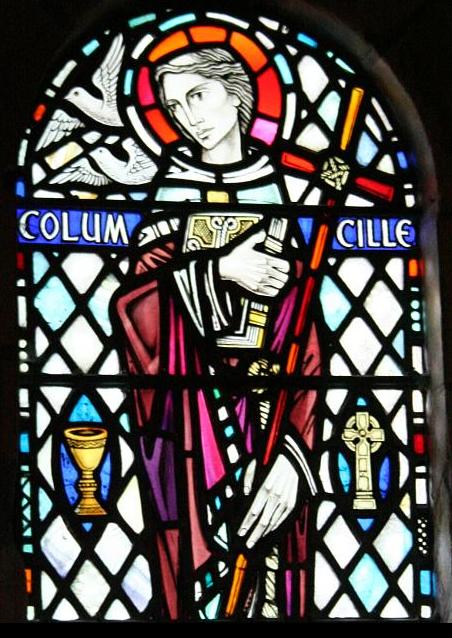
Colm Cille
The present church of Eaglais na h-Aoidhe is dedicated to St. Columba. The name Colm Cille attributed to the saint can be translated as ‘The dove of the Church (or Cell)’. Colm Cille was born of royal blood in Ireland around AD 520. Many colourful traditions abound about his early life, but he came to Dalriada in Scotland in the 560s, as mentioned, founding the great monastery of Iona and playing a crucial part in the conversion to Christianity of the peoples of Scotland. He became a figure equivalent to St. Patrick in Ireland and St. David in Wales.
Colm Cille never travelled as far as Lewis but many of his devotees spread Christian teachings far and wide. The legacy of Colm Cille remained strong in Scotland centuries after his death, and many churches built in the later Middle Ages – including Eaglais na h-Aoidhe – were dedicated to the grey eyed saint.
